Music
ThesoundofSalone
From Maroon gumbe to maringa, palm-wine and milo jazz. The recordings belong to their owners, so we point to where to hear them rather than keeping copies here.
before 1787
Roots

c. 1490–1530Side-blown ivory horn by Sapi (Temne or Bullom) carvers 
1790sAntelope-headed harp-lute, a kind no longer played in West Africa 
1800sIvory horn, probably Mende 
1800sDrum of wood, hide and beads This picture shows a Poro or Sande (Bondo) society ceremony, dancer or object. Some of what the societies do is for members only; it is shown here for its history
by 1931Gourd rattle netted with seeds, shaken by women at Bundu gatherings


- № 01
c. 1000 BC →
Kondi
The kondi is a thumb piano: a box with a row of metal tongues fixed on top, the longest in the middle, held to the chest and plucked, with a rattle adding its own buzz.
Read on +2 musiciansFold away −
The Limba call it kututen and the Loko bundoma. It belongs to a family of instruments that, by the ethnomusicologist Gerhard Kubik's estimate, first appeared on Africa's west coast about 3,000 years ago with tongues of wood or bamboo; metal tongues came later. When the kondi itself reached what is now Sierra Leone is not recorded. Sorie Kondi, born blind in the village of Mangiloko, taught himself the instrument, came to Freetown during the war in 1996 and took its name. His “Without Money No Family” came out in 2007, and from 2012 he recorded with the producer Chief Boima as Kondi Band; their album Salone followed in 2017.
Remember Kondi? Share a memory → - № 02
c. 1200s →
Balangi
The balangi is a xylophone: wooden keys on a wooden frame with small gourds hung underneath to carry the sound, played with two beaters.
Read on +1 to hearFold away −
It is played above all by the Kuranko and other peoples of Mande origin in the north, and by Temne and Limba players. It is Sierra Leone's form of the Mande balafon, whose oral histories reach back to the rise of the Mali Empire; the Sosso Bala, kept in Guinea, is said to be the first, made over 800 years ago. The traveller Ibn Battuta heard balafons at the court of Mali in 1352, and Europeans on the coast were describing the same instrument in the 1600s. In 1914–15 the anthropologist Northcote Thomas recorded balang players in northern Sierra Leone on wax cylinders.
Remember Balangi? Share a memory → - № 03
c. 1500s →
Bubu
Temne processional music for up to twenty players, each blowing a bamboo trumpet (or, today, a length of metal pipe, often an old car part) that sounds a single note, over drums, shakers and cowbells; the notes lock together into one hooting melody.
Read on +1 musicianFold away −
Legend, as told by Janka Nabay, says bubu began about 500 years ago in the village of Mange Bureh, when a young “bubu boy” took the music from witches and gave it to the public at the cost of his life. It was first played in animist ceremonies to call on the ancestors. After Fula teachers from Futa Jallon brought Islam to the Temne, it became the music of 36-hour processions during Ramadan. Janka Nabay made the first bubu recordings during the civil war, adding electric instruments, and in 2010 released the first bubu record outside Sierra Leone, in New York.
- Janka NabayThe “Bubu King” (1964–2018)Listen ↗
- № 04
1600s →
Sande songs and the segbureh
The Sande (Bondo) women's society teaches girls in the bush and brings them back to town with singing and dancing.
Read on +1 to hearFold away −
During the bush school there is song and dance each night, and the songs end with the society's moral teachings; when the initiates come home, dressed in white, they sing and dance for the whole community. The women keep time with the segbureh, a gourd wrapped in a string net threaded with shells or seeds. The first European description of the society, as “Sandy”, was published by Olfert Dapper in 1668 from an account dating to about 1628. Northcote Thomas recorded Bundu society songs on wax cylinders in 1914–15.
Remember Sande songs and the segbureh? Share a memory →
1787–1950s
Colony and Protectorate
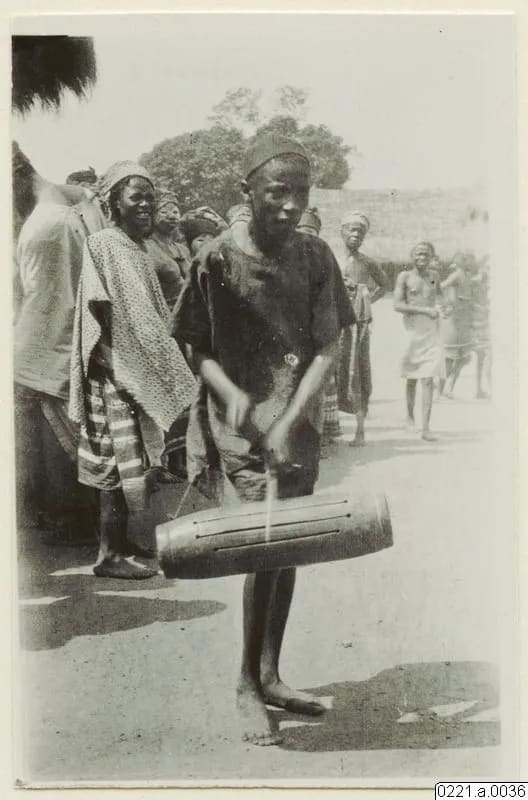
1930–31A Mende drummer 
1934The drummer who kept time for the rice-farm work, Panguma 
1935A man playing music near Panguma 
1936Musicians, Panguma
- № 05
1790s
The harp-lute
Among the things the Swedish botanist Adam Afzelius brought home from Sierra Leone, where he worked for the Sierra Leone Company between 1792 and 1796, is a harp-lute: strings over a wooden sound body, with an antelope's head carved on it.
Read on +Fold away −
It is now in the Museum of Ethnography in Stockholm, which counts Afzelius's collection the most important set of objects from Sierra Leone known in Europe before 1800, and says the instrument is of a type no longer in use in West Africa. Who played it, and for what, the record does not say; if you know an instrument like it, tell us.
Remember The harp-lute? Share a memory → - № 06
1800 →
Gumbe
After the Second Maroon War in Jamaica (1795–96), some 550 Maroons were shipped to Freetown, arriving in 1800 with the gumbe: a square drum big enough to sit on, played sitting on it or held between the knees.
Read on +1 musician · 1 to hearFold away −
It was played to enter a trance and reach the ancestors. In Freetown it is played with the maracash (bottles and tins struck together) and a carpenter's saw, in call-and-response. The drum helped bind Freetown's many Krio communities into one. From 1900 the style spread along the coast, to Mali as gube, Côte d'Ivoire as goumbe and Ghana as gome, and it is the root of asiko, maringa and milo jazz.
- Usifu JallohStoryteller and percussionist from Kamakwie, “the Cowfoot Prince”; his profile names highlife and kumbe as what he playsListen ↗
- № 07
late 1800s →
Asiko
After Britain banned the slave trade in 1807, it landed Africans freed from slave ships at Freetown.
Read on +Fold away −
Their descendants of Yoruba origin, the Aku, created asiko in the late nineteenth century: dance music on frame drums and the musical saw, later with guitar and accordion. It became one of the first popular musics shared across West Africa, and it grew out of gumbe.
Remember Asiko? Share a memory → - № 08
1914–15
The first recordings
The oldest known sound recordings made in Sierra Leone were cut on wax cylinders in 1914–15 by Northcote Thomas, a British government anthropologist touring the north.
Read on +3 to hearFold away −
Most of them are music: Temne makama songs, Bundu society songs, the kondene (a ten-string hunter's harp), the balang xylophone, and drums called saŋbori and saŋgba. On 21 October 1914 he recorded a Kuranko flute player at Mabonto, in today's Tonkolili District. The cylinders are held by the British Library, and in 2019 the [Re:]Entanglements project took copies back to the towns where they were made and recorded musicians there today.
Remember The first recordings? Share a memory →Hear it
- № 09
1920s →
Palm-wine
Kru seamen from the coast of Liberia and Sierra Leone, who worked on European ships, picked up guitars from their shipmates and worked out a two-finger picking style.
Read on +1 musicianFold away −
From the First World War it spread through the Kru towns of the port cities, Freetown among them, and was played in the bars where people drank palm wine. S. E. Rogie, born in Fonikoh in Pujehun District in 1926, turned professional in the 1940s and sang in English, Krio, Mende and Temne; his songs include “My Lovely Elizabeth” and “Please Go Easy with Me” (1960). He moved to the United States in 1973 and to England in 1988, and recorded his last album there in 1994.
- S. E. RogiePalm-wine guitarist and singer (1926–1994)Listen ↗
- № 10
1934
Drumming on the rice farm
Farm work had its own music.
Read on +Fold away −
In early 1934 the Dutch anthropologist Sjoerd Hofstra photographed men tilling the upland rice farms at Panguma, in the Mende country of the east, with a drummer playing beside them, and captioned one picture “the drummer who accompanies the work on the rice fields”. His are the oldest photographs we have found of music at work in Sierra Leone. If you have farmed to a drum, or know the songs, share what you remember.
Remember Drumming on the rice farm? Share a memory → - № 11
1940s →
Maringa
Palm-wine guitar joined to gumbe rhythm, with songs in Krio about city life.
Read on +1 musician · 1 to hearFold away −
Ebenezer Calendar, born in Freetown in 1912 to a Caribbean father and a Krio mother, trained as a carpenter and coffin maker, and first recorded maringa in the 1940s with guitar, trumpet, mandolin and cornet. With his Maringa Band he released close to 300 songs in the 1950s. In the 1960s Afro National and other bands took maringa electric.
- Ebenezer CalendarMaringa and palm-wine bandleader (1912–1985)Listen ↗
- № 12
1950s–1960s
Krio calypso
Trinidadian calypso, sung in Krio, was the sound of Freetown in the run-up to independence.
Read on +1 musicianFold away −
Ebenezer Calendar and Francis McFoy (“Famous Scrubbs”) both worked calypso into their music. Ali Ganda, born in Serabu in 1927, sang with the Carnival Star Orchestra and recorded the independence calypso “Freedom, Freedom, Sierra Leone”.
- Ali GandaCalypsonian (1927–1964)Listen ↗
1960s–1980s
Independence

1967The musicians of a dance school outside Freetown 
1982Painted cloth: two women drumming, one dancing
- № 13
1960s–1980s
Bands of the 1960s to 80s
Electric guitars, horns and soul.
Read on +7 musiciansFold away −
Geraldo Pino, born in Freetown in 1934, co-founded the Heartbeats in the 1960s. In the 1970s Afro National, Orchestra Muyei (“our country”), Sabanoh 75 and Super Combo mixed highlife, funk, soul and Congolese rumba with songs from home; Muyei toured American colleges in 1975–76. Bunny Mack's “Let Me Love You” was a disco hit in 1981, reached the British charts and earned a gold disc. King Masco's “Take Me For What I Am” (1988) was played at parties and in clubs across the country.
- Geraldo PinoSinger and bandleader of the Heartbeats (1934–2008)Listen ↗
- Afro NationalBand formed in Freetown in 1972 by Sulay Abu Bakarr, Patricia Bakarr and Ayo Roy MacauleyListen ↗
- Orchestra MuyeiDance band of the 1970s (broke up 1979)Listen ↗
- Sabanoh 75Afro-funk band of the 1970s and early 80s, “Konko”Listen ↗
- Super Combo KingsAfropop band of the early 1970s, “Memuna”Listen ↗
- Bunny MackSinger, “Let Me Love You” (1945–2015)Listen ↗
- King MascoSinger, “Take Me For What I Am” (1988)Listen ↗
- № 14
late 1960s →
Milo jazz
A fast street form of gumbe.
Read on +1 musicianFold away −
Israel Cole, born in 1944 in Leicester village near Freetown, took the name Dr. Oloh in the late 1960s and called his sound milo jazz, after the empty Milo tins his band filled with stones to shake; bottles, triangles, bass drum and harmonica filled out the band. His singles were popular across Sierra Leone from the 1970s to the early 1990s, he toured the United Kingdom, and in 1989 the government awarded him the Order of the Rokel.
- Dr. OlohMilo jazz bandleader (1944–2007)Listen ↗
- № 15
1961
High We Exalt Thee
The national anthem, adopted at independence in 1961: music by John Akar, words by Clifford Nelson Fyle.
Read on +1 to hearFold away −
Akar, an entertainer and writer and later ambassador to the United States, went on to found the National Dance Troupe two years later.
Remember High We Exalt Thee? Share a memory → - № 16
1963 →
National Dance Troupe
Set up in 1963 by John Akar, with the backing of Prime Minister Sir Milton Margai, to encourage Sierra Leoneans to take pride in their own songs, drums and dances.
Read on +1 musicianFold away −
In 1964 the troupe performed at the New York World's Fair and was given a plaque for the best performance of the fair; later that year it performed at an arts festival in London.
- John AkarFounder and first director (1927–1975)Listen ↗
- Sources
- Wikipedia: John Akar ↗
- № 17
by 1964
The tabulay, the drum that calls
The tabulay (or thabule) is a big bowl-shaped drum with one laced skin, beaten in turn by two people with ropes that end in leather pouches filled with stones.
Read on +Fold away −
It is used to call people to meetings or to prayer. The one in the Sierra Leone National Museum was cut from a mango log in 1964 at King Tom in Freetown; the museum's record links it to Teli Kolle Bangura. A 2025 photograph from Sierra Leone shows a Fula drum called the tabaldeh; we have not yet confirmed whether it is the same drum under another name.
Remember The tabulay, the drum that calls? Share a memory → - № 18
1970s →
Reggae and dancehall
Reggae took its name in Jamaica in 1968, from Toots and the Maytals' “Do the Reggay”, and its records reached Freetown in the 1970s; Jimmy Cliff first came to Sierra Leone in that decade.
Read on +2 musiciansFold away −
Dancehall followed, and local artists began to sing and toast over the rhythms in Krio. Jah Man and the Sierra Wailers, formed in the early years of the civil war, played a big concert at Victoria Park in Freetown on 11 May 1993. In December 1998 the four women of Ladies Day Out, recording for Stress Inc, released the album Focus on Africa; one of them, Linda Samai, went solo in 2003 as Star Zee. Khady Black (Khadyja Fofana) sang reggae in English, Krio and Mandingo from 2002. Sierra Leone's Refugee All Stars (below) are often heard as a reggae band, but their music rests on baskeda, a rhythm from home.
Remember Reggae and dancehall? Share a memory → - № 19
1976 →
Gospel
Church choirs sang hymns in Freetown long before, but by the account of Desmond During of the Youth for Christ studio, gospel as a popular music took off in 1976, when the Gospel Youth Singers and the Jesus Generation Youth Singers were formed.
Read on +3 musiciansFold away −
Groups such as Shield of Faith, the Melodians and Salt of the Earth followed, singing in English and Krio over styles from reggae to soukous, zouk and highlife. Vicky Fornah, who began in a Freetown church choir, became known in 1999, and Abdulai Bayoh's “Jesus So Nice” came out in 2004.
- Gospel Youth SingersGroup formed in 1976Listen ↗
- Vicky FornahGospel singer from FreetownListen ↗
- Abdulai BayohSinger, “Jesus So Nice” (2004)Listen ↗
- № 20
1980s →
Songs in Mende
Alongside the bands singing in Krio and English, singers took music in the home languages to cassette and radio.
Read on +1 musicianFold away −
Amie Kallon, born and raised in Kenema, sings in Mende with a band of eight to ten players and dancers, and her songs carry parables and Mende folklore. She was among the few artists who kept recording through the civil war (1991–2002) and spoke out publicly against the rebels.
- Amie KallonMende singer from KenemaListen ↗
1990s →
War and after

2008Usifu Jalloh, Fula drummer and storyteller from Kamakwie, in London 
2025Tabaldeh, the Fula drum
- № 21
1990s →
Salone hip-hop
Hip-hop reached Sierra Leone in the 1980s with returnees from abroad, and during the civil war (1991–2002) young people learned American rap by heart.
Read on +3 musiciansFold away −
Planet Sound's compilation of 1999 featured YOK 7, and after the war Paradise Studio released the “Paradise Family” records: Daddy Saj's “Corruption”, Matu's “Me Padi” and YOK 7's “A-Bo”, rapped mostly in Krio about reconciliation, corruption and love. Kao Denero's first album, Black Leo for Life, came out around 2003, followed by King of Freetown in 2005. Later rappers include LAJ, Drizilik, Krack Twist and Empress P.
- Daddy SajRapper, “Corruption”Listen ↗
- Kao DeneroRapper, Black Leo for Life (c. 2003)Listen ↗
- DrizilikRapper and singerListen ↗
- № 22
2000s →
Salone pop
After the war ended in 2002, new studios, instruments and radio stations carried songs in Krio across the country, mixing Afropop, R&B and hip-hop.
Read on +1 musicianFold away −
Emmerson Bockarie's “Borbor Bele” (“potbellied boy”, 2004) put the country's anger at corrupt leaders into a song that was sung widely before the 2007 election; he followed it with albums including 2 Fut Arata (2007), Yesterday Betteh Pass Tiday (2010) and Survivor (2016).
- EmmersonSinger and songwriter (born 1980)Listen ↗
- № 23
2002 →
Baskeda and the refugee years
Musicians driven out by the civil war found each other in the Kalia refugee camp in Guinea, then in the more remote Sembakounya camp, and formed a band around Reuben Koroma, Grace Koroma and Francis “Franco” Langba.
Read on +1 musicianFold away −
Their music is often heard as reggae, but they built it on baskeda, a rhythm from home. Koroma's father played it: “I used to be very close to him while they were drumming, singing and dancing.” By Koroma's account, baskeda “is about hand drums”: a big bass drum, little hand drums and shakers, and people singing. In Guinea he heard the same beats under another name, “boom boomb tah”, and at home, he says, it is “diminishing… dying off”. He hears in it “an African feel that is not in the Jamaican reggae”; a New York critic heard “the lilting baskeda drum sound reminiscent of Jamaica's nyabinghi drummers”. The dates part them even where the sound is close: reggae took its name in Jamaica in 1968 and reached Freetown in the 1970s, while baskeda was already being played in Sierra Leone in Koroma's father's day. No written source we have found dates it more closely. Sierra Leone's Refugee All Stars came home to Freetown in 2004, were the subject of a documentary in 2005, and released Living Like a Refugee (2006), Rise & Shine (2010), Radio Salone (2012) and Libation (2014).
- Sierra Leone's Refugee All StarsBand formed in the camps in 2002Listen ↗
The songs are in Mende, Temne, Krio and more. Find the words → Hear it told →
Share what you know of the music